Listening to Bob Dylan by Larry Starr
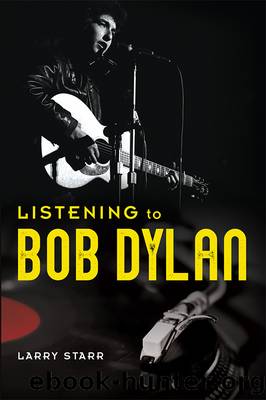
Author:Larry Starr
Language: eng
Format: epub
Publisher: University of Illinois Press
Published: 2021-01-15T00:00:00+00:00
Building Bridges
The songs on Bob Dylanâs first five albums are all strophic in form, some with choruses, and some without. On his sixth album, Highway 61 Revisited, âBallad of a Thin Manâ is the only song to break this mold. Starting out as if it will be a strophic song, as expected, âBallad of a Thin Manâ surprises with a brief bridge sectionâdefined as such by the new music that accompanies the new words, beginning with âYou have many contactsââfollowing the third strophe. After the bridge, four additional strophes, musically identical to the first three, are heard, and the song fades out.
Why did Dylan feel the need to add a bridge to âBallad of a Thin Manâ? The long strophes already have the internal variety created by the presence of a chorus (âBecause something is happeningâ), and Dylan obviously hadnât felt that his previous long songs required such a contrasting section. Perhaps the fresh music here, with the vocal melody positioned in a consistently high register, helps illuminate the lyricsâ change of perspective at this point. The scene shifts to the world outside the room/show/circus(?) where âMister Jonesâ is undergoing his experience/inquisition/education(?), and we learn of the lumberjacks who provide him with âfacts.â This âoutsideâ perspective is retained for the following strophe, with its references to professors, lawyers, and books, before we are abruptly shifted back âinside,â in the company of a sword-swallower and a mysterious midget, for the duration of the song.
Bridge sections naturally provide additional musical variety to any song, and there is also the sense of musical roundedness resulting from the return to the main music of the song after the bridge. When the musical novelty of a bridge section is paired with some new development in the lyrics, the formal structure of the whole becomes particularly satisfying. Dylan obviously seemed to be investigating this possibility with âBallad of a Thin Man.â His subsequent album, Blonde on Blonde (1966), reveals a marked new interest in experimenting with the incorporation of bridge sections into his songs. Itâs as if Dylan were asking himself which songs might have bridges, how many sections overall should songs with bridges have, and even, how many bridge sections might be placed into one song.
The traditional A-A-B-A formal structure (where âBâ is a bridge section) is found among the Blonde on Blonde songs in âJust Like a Womanâ and in âMost Likely You Go Your Way and Iâll Go Mine.â In âJust Like a Woman,â an unexpected harmony lends intensity to the start of the bridge, and that intensity is soon furthered by the lyrics, with references to âdying there of thirst,â âyour long-time curse,â and âthis pain in here.â The ending of this bridge section literally creates a âbridgeâ over to the succeeding section, musically and lyrically, by means of the phrase âAinât it clear thatâ[new section] I just canât fit.â (This is an unusual practice for Dylan, whose bridge sections typically form discrete units.) With âMost Likely You Go Your Way and
Download
This site does not store any files on its server. We only index and link to content provided by other sites. Please contact the content providers to delete copyright contents if any and email us, we'll remove relevant links or contents immediately.
The Goal (Off-Campus #4) by Elle Kennedy(13679)
Kathy Andrews Collection by Kathy Andrews(11840)
Diary of a Player by Brad Paisley(7584)
Assassin’s Fate by Robin Hobb(6226)
What Does This Button Do? by Bruce Dickinson(6209)
Big Little Lies by Liane Moriarty(5806)
Altered Sensations by David Pantalony(5106)
Pale Blue Dot by Carl Sagan(5012)
Sticky Fingers by Joe Hagan(4204)
The Death of the Heart by Elizabeth Bowen(3625)
The Heroin Diaries by Nikki Sixx(3552)
Confessions of a Video Vixen by Karrine Steffans(3311)
Beneath These Shadows by Meghan March(3310)
How Music Works by David Byrne(3272)
The Help by Kathryn Stockett(3152)
Jam by Jam (epub)(3095)
Harry Potter 4 - Harry Potter and The Goblet of Fire by J.K.Rowling(3076)
Computational Linguistics and Intelligent Text Processing: 20th International Conference, CICLing 2019 La Rochelle, France, April 7â13, 2019 Revised Selected Papers, Part I by Alexander Gelbukh(2996)
Strange Fascination: David Bowie: The Definitive Story by David Buckley(2873)
